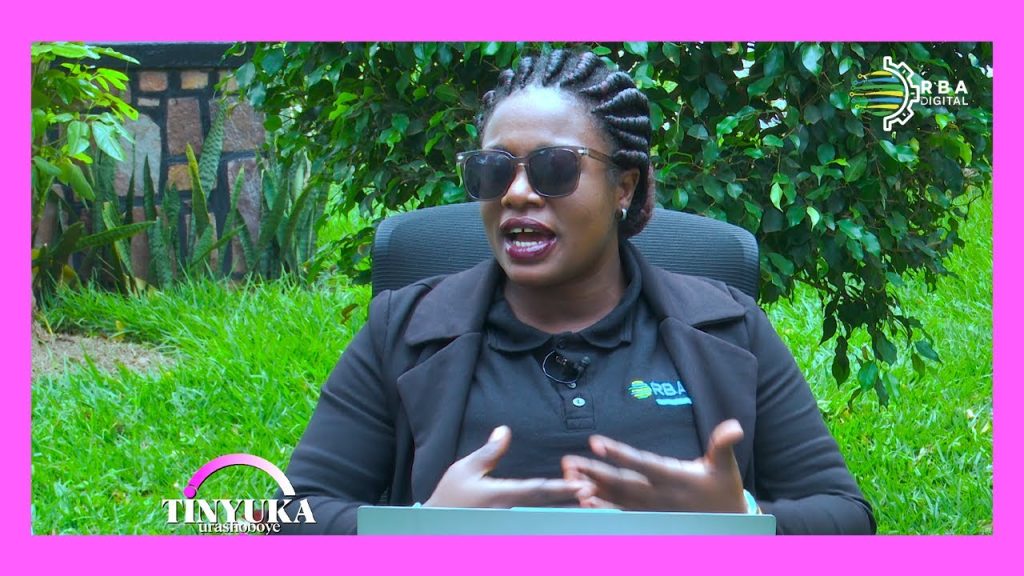
For Gato Marcelline, losing her sight at a young age did not mean losing her dreams. The Rwandan mother and journalist has defied the limitations often associated with visual impairment to build a career in journalism, where she now works for Rwanda Broadcasting Agency (RBA), particularly on Radio Rwanda.
Gato’s journey began like that of many other children, with a determination to attend school and build a future for herself. However, as she progressed through her education, she had to make difficult choices about the subjects she would pursue, taking into consideration the challenges posed by her visual impairment.
Today, she describes her position in the media as something she once considered almost impossible to achieve.
“My journey has not been easy because I lost my sight when I was young, and I had to grow up with that disability. Studying alongside children who can see is challenging, especially because there are usually very few students with disabilities in a classroom. I studied in schools that supported learners with disabilities, but God gave me the ability to learn, and I consistently performed well,” she said
One of the experiences that strengthened her confidence was being recognised by Imbuto Foundation for her strong academic performance. The recognition, she says, changed the way she viewed herself and convinced her that disability should not define the limits of her ambitions.
“Being awarded as one of the girls who performed exceptionally well gave me the strength to believe that anything was possible. I stopped seeing myself simply as a girl with a disability. I realised that if my hard work could earn me such recognition, I could go much further. It also made me understand that education should not simply be about completing school; I needed to work hard so that I could eventually use my experience and voice to advocate for others,” Gato said
Her academic choices also played an important role in shaping her career. Although she was capable of performing well in sciences, she found practical components more difficult because of her visual impairment. She therefore chose to focus on languages and literature, subjects that eventually opened the door to journalism.
“I was a strong student and performed well in many subjects, including science, but I realised that studying sciences with a visual impairment could be difficult because of the practical work involved. I chose languages and literature instead. I studied at Groupe Scolaire de Gahini for my secondary education and later joined the University of Rwanda’s Huye Campus, where I graduated in Journalism and Communication,” she said
For Gato, however, academic qualifications alone were not enough. She believes that progress requires courage, persistence and the determination to demonstrate what one is capable of doing, rather than allowing other people’s perceptions to dictate one’s future.
“The most difficult part of the journey is refusing to give up and standing firmly on what you are capable of doing. I did everything I could to demonstrate my abilities, and people came to appreciate what I could contribute,” she said
Working in journalism has also taught her that success requires continuous learning. According to Gato, journalists must constantly follow new developments because news is constantly changing and the profession requires persistent research.
Her university years were equally demanding. With limited resources, she says, she had to make sacrifices and carefully manage the financial support she received so that she could prepare herself for professional life.
“It was very challenging and required sacrifices. During university, I had to carefully manage the little living allowance I received so that I could save enough to support my professional training and ensure that financial difficulties did not prevent me from gaining the experience I needed. It required planning and sacrifice,” she explains.
Gato also understood that building a successful career required her to earn the trust of the people around her. Rather than expecting others to lower their standards because of her disability, she worked to demonstrate that she could perform her responsibilities effectively.
That determination eventually took her to Radio Rwanda, a moment she describes as one of the most memorable achievements of her career.
Although she had spoken on radio before, her first appearance on Radio Rwanda came with a different level of pressure. She knew that the station had a wide audience and admits that she was nervous before going on air.
“The day I first spoke on Radio Rwanda was incredibly emotional for me. I kept thinking about the fact that I would be heard by people across the country, and I was very nervous. I prayed that God would help me do well. When people responded positively, it gave me even more confidence and strength,” she recalled
Gato has since become a familiar voice to many listeners, particularly through programmes such as Bwakeye Bute, which she presented alongside Bright Turatsinze, as well as Kazi ni Kazi and other programmes in which she has participated. Her colleagues and audiences have continued to recognise her ability to perform her work professionally despite her visual impairment.
Rather than considering her current position the end of her journey, Gato sees it as a foundation from which to pursue even greater ambitions. She says she intends to continue learning, working hard and looking for opportunities to achieve more than she has already accomplished.
Her story also carries a message to other Rwandans, particularly women and girls living with disabilities. She encourages them not to surrender to discouragement, but instead to identify and make the most of opportunities available to them.
She believes Rwanda’s security, inclusive policies and opportunities provide an environment in which people can pursue their ambitions regardless of the challenges they face.
Source: RBA/RTV (Tinyuka urashoboye)